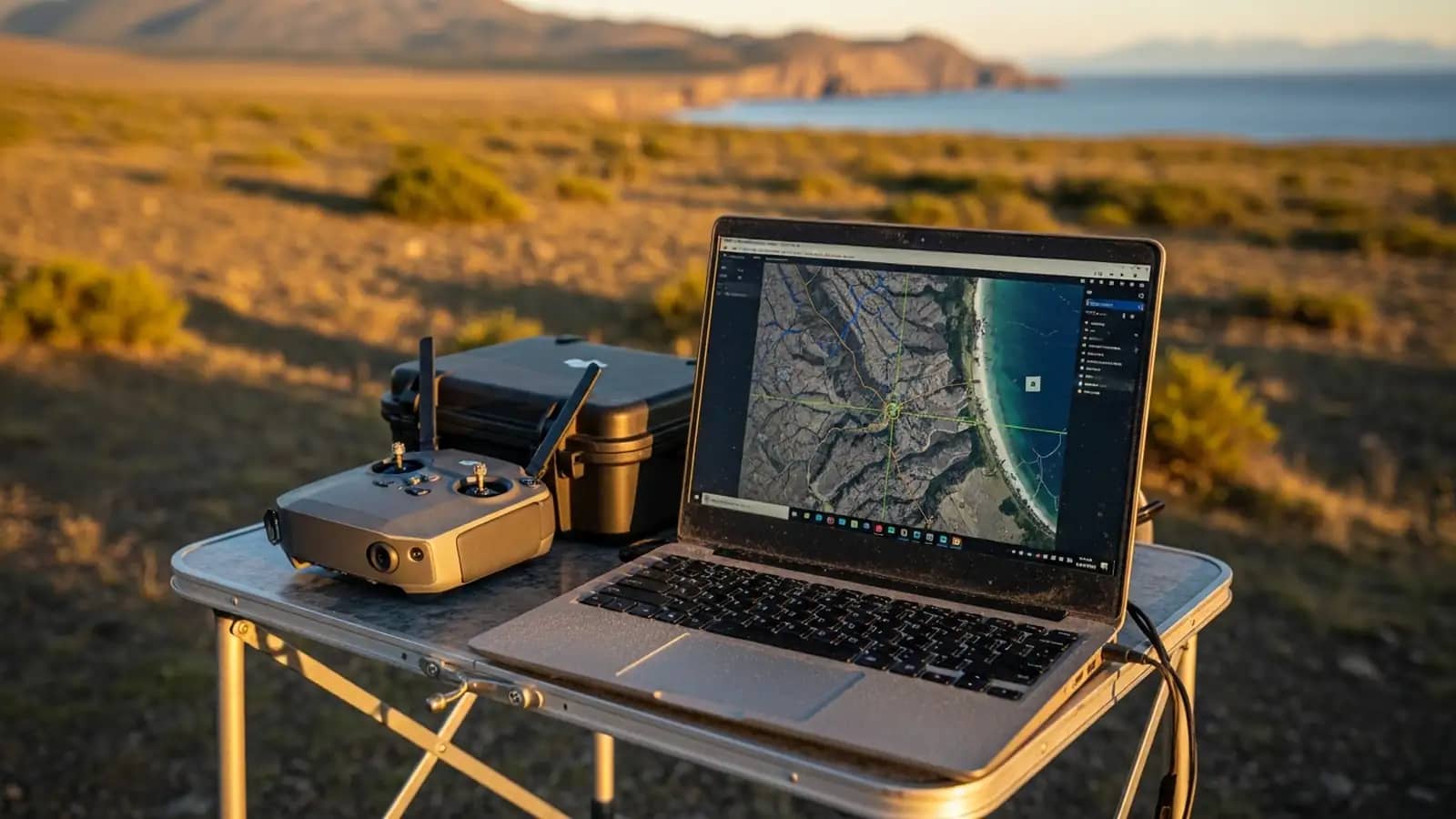
Clementina gathers drone surveys to turn them into products useful for research and environmental management.
Four gaps limiting the use of drone surveys in Patagonia today.
Disks fill up and many surveys are lost over time.
Sites monitored by different people or institutions can rarely be analyzed jointly.
The lack of common standards limits comparison between surveys done at different times and places.
Centralizing and organizing data makes it easier to turn it into products that support research and conservation.
Clementina promotes open access to information while always respecting those who generate the data.
Open data does not mean ownerless data.
What you gain when you share a survey on the platform.
Derived products and the information associated with the survey remain available for future queries and new analyses, regardless of changes in equipment or institutions.
Every published survey includes a ready-to-use reference for reports, presentations or scientific publications.
The surveyed area can be added to the public map, showing the collective reach of the monitoring network.
Every survey is reviewed before publishing, prioritizing quality and context over automated processes.
You decide whether your survey will be public, collaborative or restricted.
Clementina does not charge subscriptions nor commercialize information uploaded by users.
Published products preserve the information about who generated the data and the institutions involved.
Every new survey strengthens a community building useful information for science, conservation and environmental management.

Clementina Patagónica takes its name from Clementina, the first scientific computer used in Argentina, driven by Manuel Sadosky at the University of Buenos Aires in 1961. Decades later, a homonymous computer once again processes scientific data, transforming drone surveys into geospatial products for environmental monitoring and conservation.
More than a historical reference, the name recovers an Argentine tradition of science and technology at the service of knowledge, territory, and the construction of public capacities.
“We propose to develop a science and a technology at the service of the country, to enable and structure its development.